

The Hario V60 is a staple on the countertops of specialty coffee enthusiasts across the Baltics and Scandinavia. Its steep 60-degree angle and large exit hole give you complete control over your extraction. This classic design is highly receptive to different pouring styles, meaning a slight tweak to your recipe can completely alter your cup.
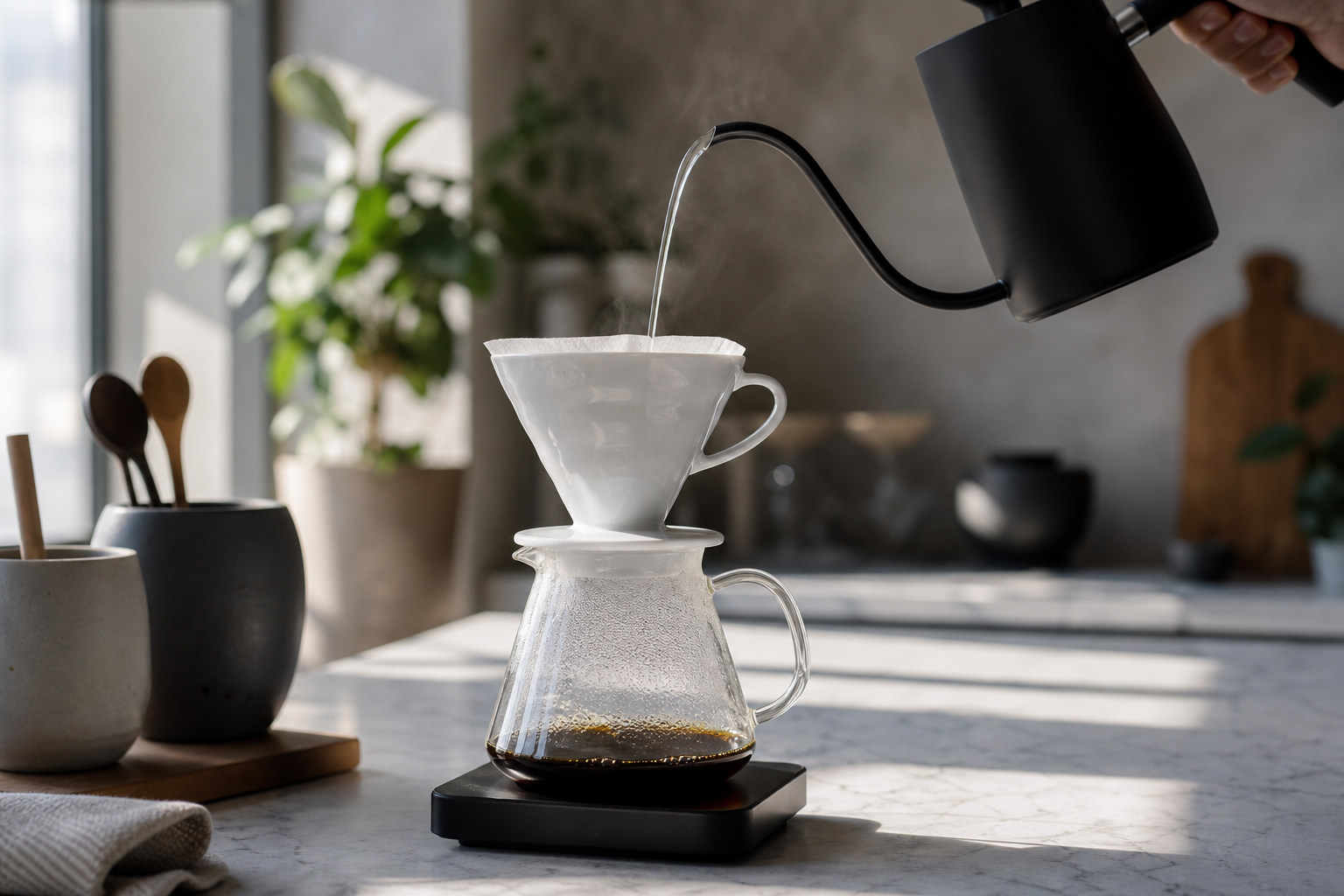
If your home brews taste a bit flat, bitter, or inconsistent, the solution usually lies in how you manage your variables. Adjusting your technique is an easy way to elevate your morning routine. Here is a comparison of three proven pouring methods to help you get the most out of your beans.
Comparison of V60 recipes
| Method | Coffee (g) | Water (g) | Ratio | Grind Size | Target Time | Taste Profile |
|---|---|---|---|---|---|---|
| Single-Cup Pulse | 15 g | 250 g | ~1:16.7 | Medium-fine | 3:00 mins | High sweetness, balanced acidity, great clarity |
| Five-Pour Routine | 15 g | 250 g | ~1:16.7 | Medium | 2:45–3:00 mins | Vibrant, bright acidity, highly defined notes |
| Classic Larger Brew | 22 g | 360 g | ~1:16.4 | Medium-coarse | 3:00–3:30 mins | High body, intense sweetness, structured |
Core brewing variables
Before jumping into the step-by-step pouring methods, it helps to review the foundation of your brew.
First is your grind size. Generally, pour-over coffee requires a medium to medium-fine grind size, resembling coarse sand or fine sea salt. We recommend using a high-quality hand grinder to ensure a consistent grind. Cheap grinders produce too many micro-particles (known as fines) that block your filter paper, causing your water to stall and over-extract.
Second is the coffee-to-water ratio. A range of 1:15 to 1:17 works beautifully for filter coffee. Going closer to 1:15 provides a heavier body, while 1:17 yields a lighter, tea-like cup.
Finally, consider your water. In our region, we are blessed with relatively soft tap water, but paying attention to water quality is still vital. For light roasts, we recommend keeping your water temperature high – between 93°C and 96°C. If you are brewing something slightly more caramelized, dropping to 90–92°C keeps your cup tasting sweet and balanced.
[products ids='15633509482826,15446350299466,15609150603594']
Single-cup pulse method
This technique is inspired by modern single-cup competition profiles. It uses small, pulsed pours to keep the water temperature inside the coffee bed highly stable, yielding exceptional sweetness and balance.
For this method, we recommend pairing a ceramic dripper with high-quality paper filters.
- Rinse and preheat: Place your paper filter in the dripper and rinse it thoroughly with hot water. This washes away any papery taste and preheats your ceramic cone. Discard the rinse water.
- The bloom (0:00 - 0:45): Add 15 g of medium-fine ground coffee. Pour 50 g of water quickly. Give the dripper a gentle swirl to ensure all the grounds are wet. Let it rest for 45 seconds to release trapped gases.
- The second pour (0:45 - 1:00): Pour in slow, circular patterns up to 100 g. Keep the spout of your kettle close to the coffee bed to minimize unwanted turbulence.
- The pulses (1:00 - 1:40): Add water in 50 g increments every 20 seconds. Pour to 150 g at 1:00, 200 g at 1:20, and finally up to 250 g at 1:40.
- The final swirl (1:40 - 3:00): Once you finish your final pour, give the brewer one last, gentle swirl. This prevents coffee grounds from clinging to the sides and ensures a flat bed for an even drawdown.
Five-pour structure
This method divides your total brewing water into five aggressive, equal pours. It is highly effective for bright, washed coffees where you want to highlight sparkling acidity and floral aromas.
- Prep: Set up your V60 with 15 g of medium-ground coffee.
- First pour (Bloom): Pour 50 g of water aggressively in a spiral, starting in the middle and moving outward.
- Subsequent pours: Once the water level in the dripper drops and is just about to disappear into the coffee bed, pour another 50 g.
- Repeat: Repeat this process until you reach 250 g total (five pours of 50 g). Because you are pouring forcefully, you do not need to stir or swirl. The stream of water does all the agitation for you.
Classic larger brew
When you are brewing for two, a larger dose is necessary. This recipe uses a 22 g dose of coffee to 360 g of water, requiring a slightly coarser grind size to handle the deeper coffee bed.
- The bloom (0:00 - 0:45): Pour 66 g of water over your grounds. In our experience, a quick, gentle stir with a spoon during the bloom helps wet every grain of coffee in a deep bed.
- The main pour (0:45 - 1:35): Pour quickly and continuously in a vertical stream up to the full 360 g.
- The crust stir (1:35): Give the top surface a gentle stir to knock down any grounds stuck to the filter.
- The spin (2:00): Give the V60 a final swirl. Let the water draw down completely, aiming for a total brew time of 3:00 to 4:00 minutes. Serve your brew in a clean glass vessel.
Pouring mechanics and agitation
Understanding how your water stream impacts the coffee bed is the secret to consistency. Every time water hits the grounds, it creates turbulence. This agitation increases how fast the coffee extracts.
If you pour too aggressively, you risk pushing micro-particles down to the bottom of the filter, clogging the pores and causing your brew to stall. If you pour too gently, you may leave dry pockets of coffee untouched.
Many of our customers tell us that aiming for a flat, uniform coffee bed at the end of the drawdown is the easiest way to verify their technique. If your coffee bed is flat, your extraction was even. If it looks like a deep cone with thick mud on the sides, some coffee extracted more than the rest.
Coffee selection for Nordic brewing
Light roasts are the hallmark of our coffee culture. Because light roasts preserve the unique characteristics of the soil, altitude, and variety, they are highly sensitive to your brewing technique.
If you love bright, jammy, and sweet cups, the Good Life Coffee Shantawene Ethiopia Natural – with its lovely notes of blackcurrant jam and violet – is a superb match for the single-cup pulse method. For a classic, comforting morning cup, Kalve Coffee Breakfast Club Brazil Natural brings rich tones of almond and caramel that shine with the classic larger brew.
[products ids='15593841951050,15613878665546,15633509974346']
Your next coffee ritual
Small adjustments to your pouring structure, grind size, and water temperature can make your daily cup taste like it was prepared by a professional barista. If your coffee tastes too sharp or sour, try grinding a touch finer or adding a pulse to your pour. If it tastes dry or bitter, coarsen your grind and pour more gently. Grab a fresh bag of filter beans from our shop, choose one of these recipes, and find out how a few small changes can transform your morning brew.