

Ever brewed a beautiful coffee at a local cafe, only to recreate a watery disappointment at home? In our experience, the secret to consistency isn't a magical pouring technique. It simply comes down to weighing your coffee and water in grams to find your ideal ratio.
Recommended brew ratios at a glance
Weighing your coffee beans with a digital scale keeps your morning routine simple. To make things easy, we compiled this guide to the most common manual brewing methods.
| Brewing method | Recommended ratio range | Starter recipe | Taste profile |
|---|---|---|---|
| Pour-over (V60 or Chemex) | 1:15 to 1:17 | 15g coffee to 250g water | Clean, vibrant, high clarity |
| French press | 1:14 to 1:16 | 30g coffee to 450g water | Rich, full-bodied, textured |
| AeroPress (Standard) | 1:15 to 1:16 | 15g coffee to 225g water | Smooth, balanced, clean |
| Espresso | 1:1.5 to 1:2.5 | 18g coffee to 36g water | Intense, syrupy, concentrated |
| Cold brew (Concentrate) | 1:4 to 1:8 | 100g coffee to 600g water | Heavy, sweet, low acidity |
To calculate your water or coffee needs, use these two simple formulas:
- To find your water weight: Coffee weight (g) × Ratio target = Water weight (g)
- To find your coffee dose: Water weight (g) ÷ Ratio target = Coffee weight (g)
Mechanics of strength and extraction
To brew a delicious cup, we need to separate two basic concepts: strength and extraction.
Coffee strength refers to the concentration of dissolved coffee solids in your cup. If you use more coffee and less water, you get a stronger, more intense drink. If you use less coffee, the brew feels thin and weak.
Extraction is the actual percentage of flavor compounds you pull out of the dry grounds. The specialty coffee community generally targets an extraction yield of 18% to 22% for a balanced profile. If you extract too little, your cup tastes sour and salty. Extract too much, and it becomes bitter and dry.
Many of our customers tell us they get frustrated when a brew is too intense. In our experience, if your extraction is balanced but the coffee is too strong, you can easily adjust it after brewing. Simply add a small splash of hot water to your cup. This dilutes the intensity without altering the beautiful flavor balance you already extracted.
Pour-over methods and ratios
For pour-over drippers, a ratio range of 1:15 to 1:17 is the industry standard. A 1:15 ratio yields a punchier cup, whereas a 1:17 ratio highlights delicate floral notes and bright acidity.
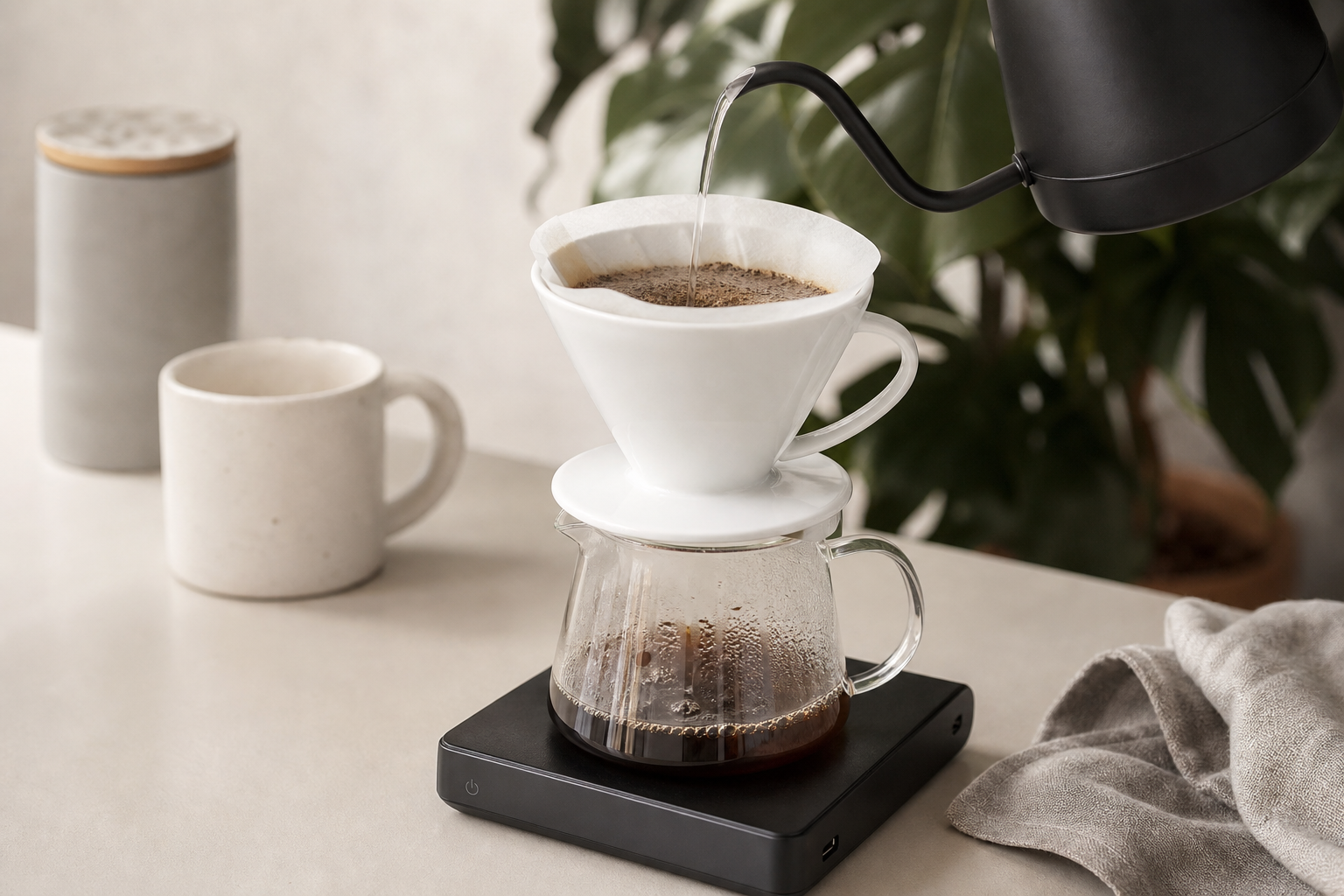
When using a conical dripper, precise water control is vital. We recommend a 1:16 ratio for daily filter brewing to highlight the juicy characteristics of light-roasted beans.
[products ids='15633509482826,15446350299466']
For a larger batch, a Chemex is an excellent choice. Its thick paper filters trap heavy oils and fine particles, producing an ultra-clean cup. We recommend a slightly wider 1:16.6 ratio (such as 30 grams of coffee to 500 grams of water) to let those delicate flavors breathe.
[products ids='15446350332234,15446350168394']
Immersion methods and ratios
Immersion methods keep water and coffee in contact for the entire brew time. This approach typically requires a slightly tighter ratio because the extraction process is naturally less efficient than pour-over.
For a French press, a 1:15 ratio provides a reliable balance of heavy body and rich sweetness. If you are brewing a highly soluble, darker roast, you might extend this to 1:17 to prevent the cup from tasting overly bitter.
The AeroPress is highly versatile. For a standard, filter-like cup, a 1:15 ratio works wonderfully. However, you can also opt for a highly concentrated 1:5 ratio to create an espresso-style base, which you can then dilute with hot water or warm milk.
To make these precise adjustments, a reliable hand grinder with micro-step settings is a helpful companion.
[products ids='15446350266698,15609150603594']
Espresso ratios for dense texture
Espresso brewing uses intense pressure to force water through a compact coffee puck. Because of this, the ratios are much tighter than any filter method.
- Ristretto (1:1 to 1:1.5): An exceptionally dense, syrupy shot with concentrated sweetness and low clarity.
- Normale (1:1.5 to 1:2.5): The classic specialty standard. An 18-gram dose yielding 36 grams of liquid espresso (a 1:2 ratio) provides a beautiful balance of acidity, body, and sweetness.
- Lungo (1:3 to 1:4): A wider, more diluted shot that emphasizes clarity and individual origin characteristics.
Many of our customers tell us that shifting from a standard 1:2 ratio to a slightly longer 1:2.2 ratio helps open up the stone fruit and floral notes in delicate East African coffees.
Adjustments for taste balance
Every coffee bean behaves differently based on its roast profile, origin, and freshness. If your coffee doesn't taste quite right, try these simple troubleshooting steps:
- Bitter or dry taste: You have likely over-extracted. Try a slightly coarser grind or decrease your water temperature.
- Sour or salty taste: You have under-extracted. Try grinding finer or using hotter water.
- Ideal balance but heavy feel: Keep your grind size and temperature the same, but use a wider ratio (like 1:16 instead of 1:15). Alternatively, add a tiny splash of water to your finished cup.
Using high-quality speciality filter coffee is only half the equation. Since water makes up nearly 98% of your filter brew, using the right brewing water is equally critical to unlocking those delicate flavor notes.
Next steps for better extraction
Achieving a stellar cup of coffee at home is entirely within your reach. By stepping away from spoons and using a digital scale to track your coffee-to-water ratios, you eliminate the guesswork from your morning routine.
Grab a fresh bag of beans, set your scale to grams, and start brewing with precision today.