

Did you know that your freshly brewed cup of filter coffee is actually 98% water? If your morning brew tastes flat despite using premium beans, the culprit is likely flowing directly from your kitchen tap.

The role of minerals in extraction
Water needs minerals to pull the delicious compounds out of your coffee grounds. Pure, distilled water is actually a poor solvent for coffee. To get a balanced extraction, the Specialty Coffee Association (SCA) targets a total dissolved solids (TDS) level between 75 and 250 mg/L, with 150 mg/L being the sweet spot.
Two main minerals do the heavy lifting: magnesium and calcium. Magnesium is highly efficient at pulling out volatile flavor compounds. It accentuates the juicy acidity and vibrant sweetness of light roasts. Calcium contributes to a round, creamy body. However, too much calcium can lead to a heavy, chalky mouthfeel, which masks delicate floral characteristics.
Buffer and acidity control
The balance between sourness and bitterness in your cup relies heavily on water alkalinity. Measured as bicarbonate, alkalinity acts as a buffer against acid. The SCA recommends keeping your alkalinity level between 40 and 70 ppm.
Think of alkalinity as a volume dial for acidity. If your water has too much buffer, it completely neutralizes the natural fruit acids in the bean. This leaves you with a dull, flat, and muddy brew where you cannot easily perceive the subtle tasting notes printed on your coffee bag. Conversely, when alkalinity is too low, the acids run wild, resulting in a sharp, vinegary sourness.
Regional tap water in the Baltics and Scandinavia
Your home brewing experience depends heavily on your geography. In our experience, home brewers across the Baltics and Scandinavia face completely opposite water challenges.
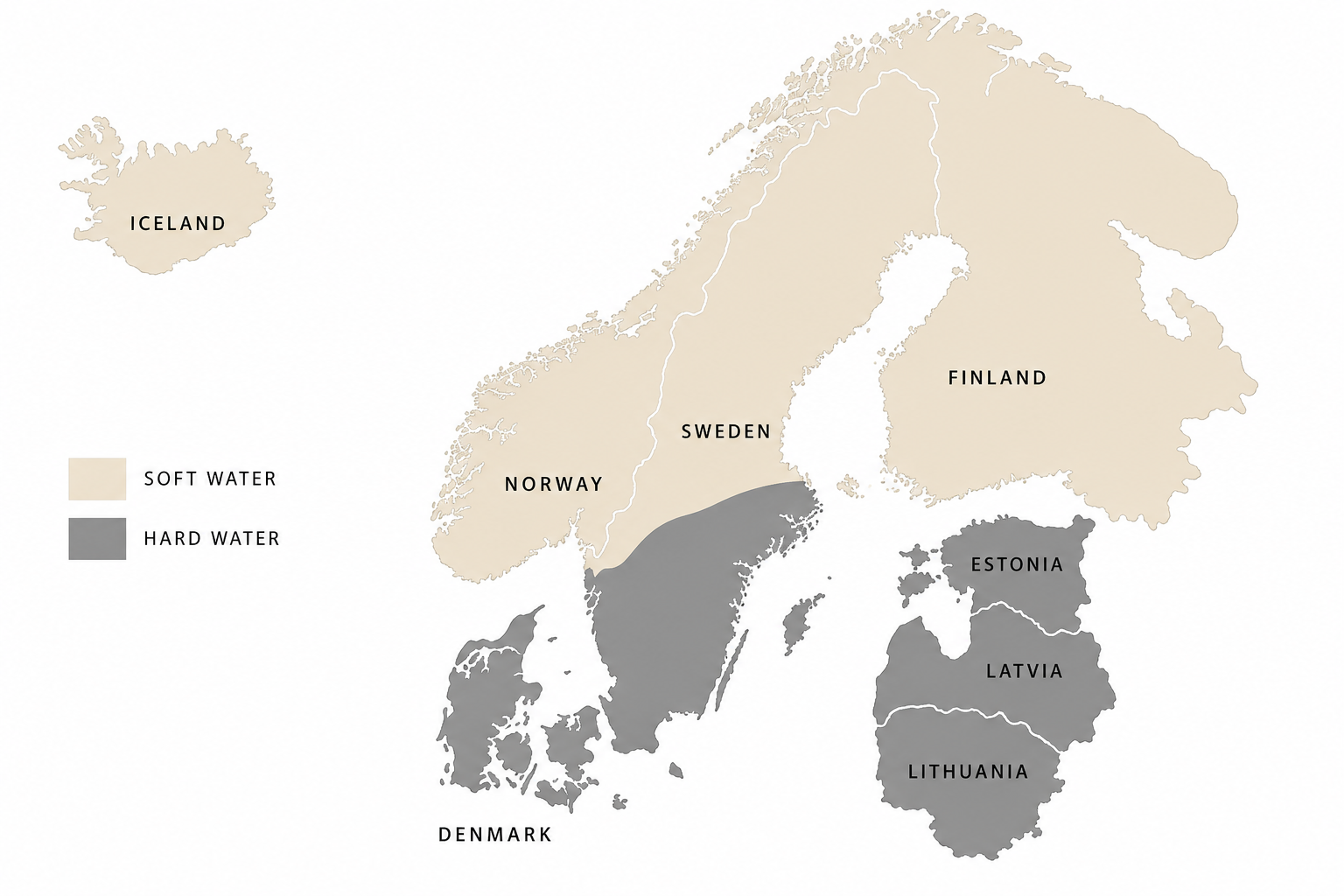
If you live in Norway, Finland, or Iceland, you are blessed with some of the softest tap water in the world, often sitting well below 50 mg/L of total hardness. While this is great for keeping your kettle free of limescale, very soft water can sometimes result in under-extracted, thin-tasting cups.
If you are brewing in Denmark, Latvia, Lithuania, or northern Estonia (including Tallinn), you face the exact opposite challenge. The groundwater here flows through limestone bedrock, making the tap water hard to extremely hard, often exceeding 180 mg/L or even 300 mg/L. This high mineral concentration mutes the sparkling acidity of high-quality filter coffee. Sweden sits somewhere in the middle, with soft water in coastal and northern areas, but moderately hard to hard water in southern regions like Skåne.
Filtration methods for home brewers
To get the most out of your coffee beans, you need to manage your local water quality. Different filtration methods solve different problems:
- Activated carbon: Standard pitcher filters use carbon to trap chlorine and chloramines. This is essential because chlorine reacts with coffee to produce harsh, chemical off-flavors. However, carbon filters do not remove mineral hardness.
- Ion exchange: These systems swap calcium and magnesium ions for sodium ions. They are excellent for preventing scale buildup in espresso machines, but they can sometimes leave your filter coffee tasting a bit soft and flat.
- Reverse osmosis: This system strips almost all minerals from the water. Because fully demineralized water results in a weak, hollow cup, we recommend using a system with a bypass valve to blend some tap water back in, or adding commercial mineral packets directly to pure water.
Practical tips for a better cup
If your local tap water is hard, a simple carbon pitcher filter will help with chlorine, but you might need to dilute your tap water with distilled or reverse osmosis water to lower the mineral content. This extra step will immediately unlock the vibrant, clean flavors of your manual brews. Many of our customers tell us they noticed an immediate upgrade in flavor simply by switching from tap water to filtered water.
If you brew with extremely soft Scandinavian water and find your cups tasting thin, you do not need to struggle. We recommend trying a slightly finer grind to increase contact time and boost extraction. Using a high-quality manual dripper or immersion brewer can also give you more control over the extraction process.
[products ids='15633509482826,15446350266698']
Investing in a precise grinder is another highly effective way to manage extraction issues caused by your water chemistry. Adjusting your grind size by just a few clicks can easily compensate for water that is slightly too soft or too hard.
[products ids='15609150603594']
Once you align your water chemistry with your brewing technique, you will notice a massive difference in your daily cup. For a great test of your water setup, try brewing some pour-over coffee and observe how the flavor clarity changes.
Ready to taste the difference that balanced water makes? Grab a bag of light-roasted specialty beans from our curated collection, dial in your water, and experience the true potential of your favorite origins.