

Different drippers require unique approaches because the shape of the filter changes how water moves through the coffee grounds. We have compiled this reference for the most common brewing techniques to help you choose the right method for your morning ritual.
| Method | Ratio | Grind Size | Temp | Characteristics |
|---|---|---|---|---|
| Hario V60 | 1:16 | Medium-fine | 94°C | High acidity, clean body |
| Kalita Wave | 1:15 | Medium | 93°C | Round sweetness, balanced |
| Chemex | 1:17 | Medium-coarse | 92°C | Tea-like clarity, light body |
| AeroPress | 1:14 | Fine-medium | 90°C | Rich mouthfeel, intense flavor |
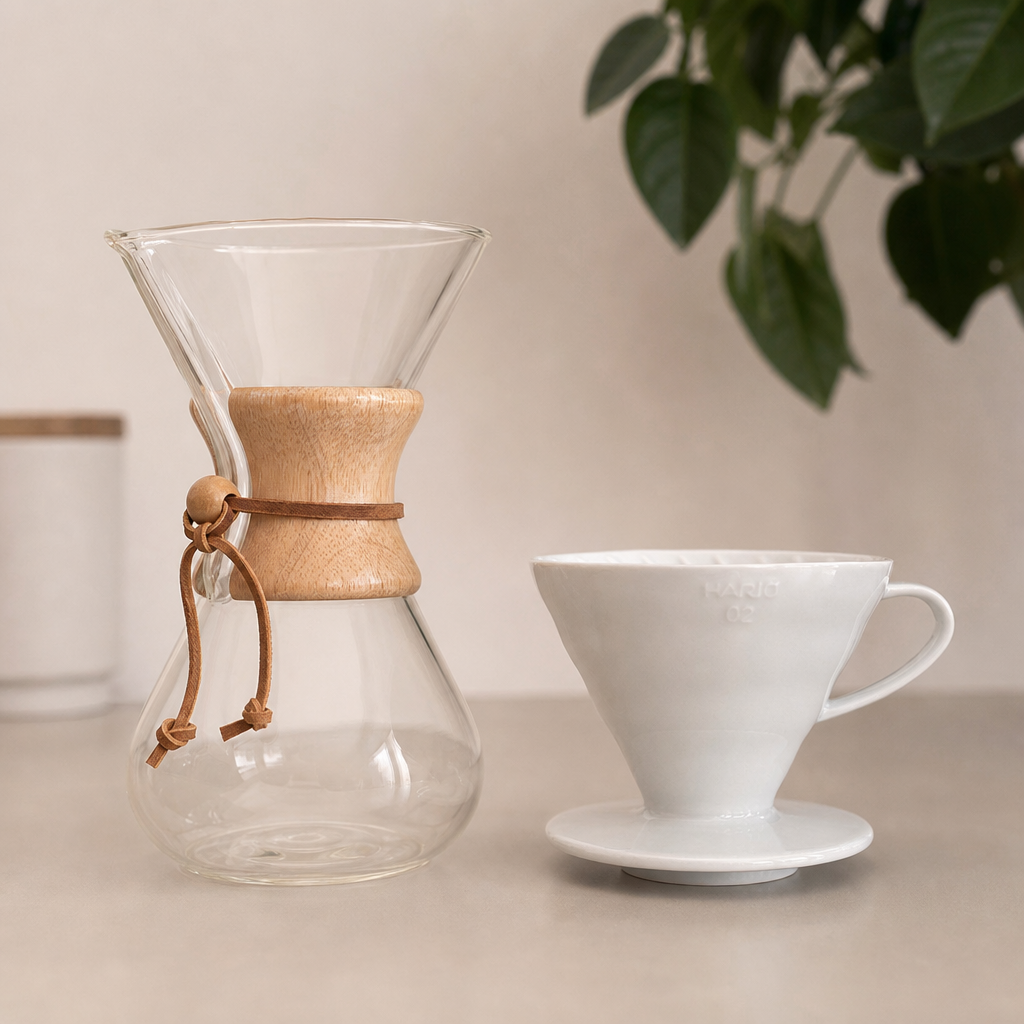
For those who want a tea-like clarity, the Chemex is a design icon that uses thick filters to trap oils. If you prefer something more classic and sharp, the Hario V60-02 ceramic dripper holds heat steady to help you pull every nuance from your beans.
[products ids='15633509482826,15446350332234']
Essential equipment for consistency
Brewing coffee without a scale is a bit like baking a cake by eyeing the flour – you might get lucky, but it often ends in a mess. To get repeatable results, we recommend using a burr grinder, a digital scale, and a gooseneck kettle for a steady pour.
Once you stop guessing and start measuring your coffee-to-water ratio, your coffee quality improves almost immediately. A good grinder, like the Timemore Chestnut C3S Max, ensures your grounds are uniform, which prevents the mix of sour and bitter flavors that come from inconsistent particles.
[products ids='15609150603594,15633509974346']
Step-by-step brewing process
Start by placing your filter in the dripper and rinsing it thoroughly with hot water. This simple step removes any papery taste and warms up your equipment so the brewing temperature stays stable. Discard the rinse water before adding your freshly ground coffee.
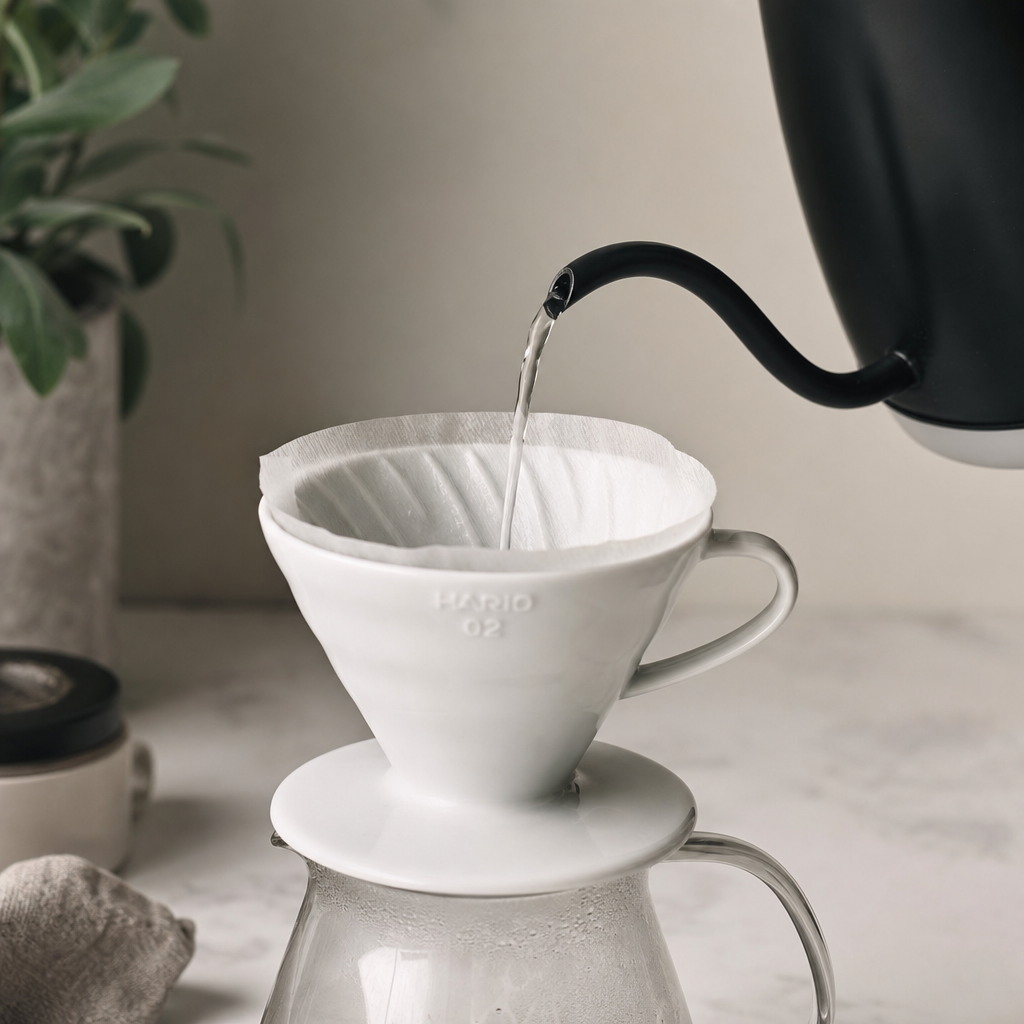
- The bloom: Begin the brew by pouring about double the weight of the coffee in water (e.g., 60g of water for 30g of coffee). Wait 30–45 seconds. You will see bubbles forming as the coffee releases CO2, which allows the water to extract flavor more effectively.
- The main pour: Pour in a gentle spiral motion, starting from the center and moving outward. We recommend avoiding the walls of the filter so water does not bypass the coffee.
- Pulse pouring: Many of our customers tell us that breaking the pour into two or three stages helps increase sweetness.
- The drawdown: Let the water draw down completely. Your final coffee bed should look flat and even, which shows that the water flowed through all the grounds equally.
Adjustments for regional water
In the Baltics and Scandinavia, we often have very soft tap water. While this is great for drinking, soft water in cities like Tallinn, Stockholm, or Turku can sometimes lead to under-extraction. Without enough minerals to help pull out the flavors, even the best beans can taste a bit dull.
If your coffee feels thin despite a good recipe, try using a slightly finer grind or a higher water temperature. We have a detailed guide on finding the water for brewing that can help you balance your mineral content and bring back that missing vibrance.
Solutions for common flavors
If your coffee does not taste quite right, it usually just needs a small tweak. Think of brewing as a fun experiment where you get to enjoy the results. Change only one variable at a time to find your sweet spot.
- If the coffee is too sour, your grind is likely too coarse or your water too cool – try a finer setting next time.
- If the coffee is too bitter, you might have ground the beans too fine or used water that was boiling hot.
- If the coffee feels too weak or watery, adjust your ratio by using slightly more coffee per gram of water.
By focusing on these small details, you can turn a standard morning cup into something extraordinary. To get started with a fresh profile, we recommend the bright and floral Shyira Washed by Good Life Coffee or the consistently fruity Karimikui by Morgon Coffee Roasters.
[products ids='15593842180426,15593841230154']