

Brewing specialty coffee is a delicate interplay of physical variables. When hot water hits ground coffee, hundreds of soluble compounds dissolve at different rates. Balancing your cup comes down to controlling how fast and how evenly those solubles move from the coffee bed into your liquid brew.
Two core metrics measure this transformation: Total Dissolved Solids (TDS) and extraction yield. TDS measures brew strength, or how concentrated the dissolved solids are in your cup. Extraction yield measures the percentage of the original ground coffee mass that dissolved into the water. Controlling both relies on four physical factors: particle size, water temperature, pressure, and contact time.
Grind size and surface area
Ground coffee particle size directly dictates how much surface area interacts with water. Finer particles expose more cellular structure, accelerating the rate of extraction. In controlled brewing tests, reducing particle size can boost total extraction yield by over 60 percent.
Grinding finer also creates microscopic fragments called fines. A high proportion of fines creates a tight coffee bed, lowering water permeability and extending brew time. When water stalls, over-extraction occurs. This draws out harsh phenolics that cause astringency and lingering bitterness. In our experience, keeping particle size consistent is the single biggest step toward cup clarity.
Coarser grinds allow water to pass through quickly. This setting works well for pour-over methods with thick paper or long immersion brews. If your coffee tastes hollow or overly sour, your grind setting is likely allowing water to flow past without dissolving enough desirable sugars and organic acids.
Water temperature and thermal energy
Water temperature provides the thermal energy required to dissolve coffee compounds. Higher temperatures increase the rate of extraction, pulling acids, sugars, and bitter compounds out of the grounds much faster.
Sensory research reveals that across brewing temperatures between 87°C and 93°C, overall flavor profiles stay remarkably consistent if total strength and extraction yield are kept equal. Temperature acts primarily as a physical accelerator.
For light specialty roasts, higher temperatures around 93°C to 96°C help dissolve dense sugars trapped inside light, dense beans. Darker roasts benefit from cooler water around 88°C to 90°C to prevent excessive extraction of heavy, smoky notes. The mineral makeup of your water also affects extraction efficiency, as detailed in our guide on water for coffee brewing.
Pressure dynamics and fluid flow
Pressure fundamentally changes fluid dynamics inside the coffee bed. In immersion or standard pour-over setups, water moves through the grounds driven only by gravity and atmospheric pressure. Espresso brewing, by contrast, uses a pump to force water through a compact coffee puck at around 9 bars of pressure.
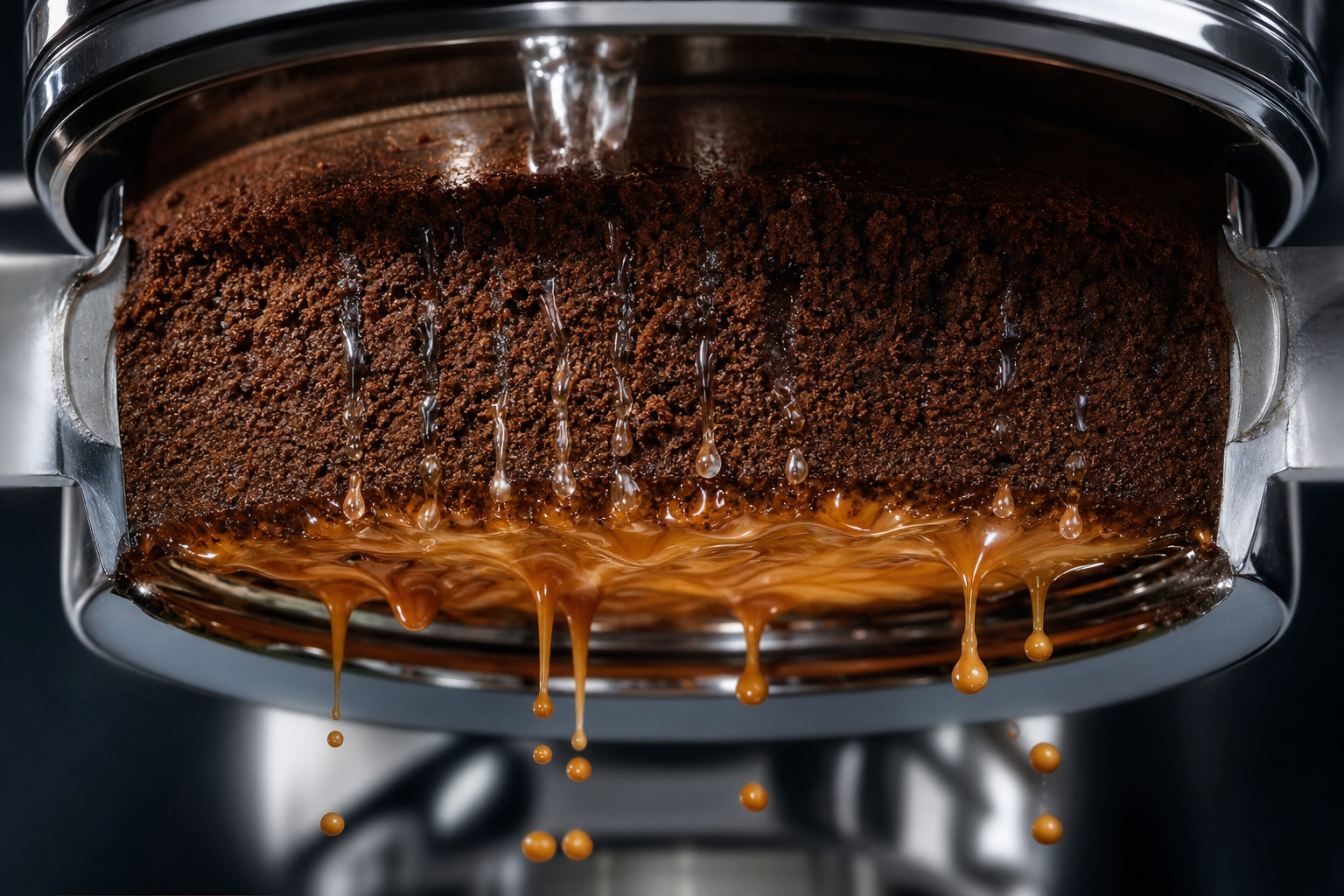
Applying pressure accelerates extraction, emulsifies coffee oils, and creates crema. However, higher pressure is not always better. Research on extraction pressure shows that extractions at 9 atmospheres preserve a vibrant percentage of pleasant volatile aromatics – such as fresh, fruity, and malty notes – while higher pressures tend to push harsh roast character forward.
Low-pressure preinfusion gently saturates the coffee puck before main extraction begins. This initial dampening swells the grounds, reducing bed resistance and preventing channeling – where water carves path-of-least-resistance channels through the bed and causes uneven extraction. Many of our customers tell us that manual pressure devices offer a fantastic way to experiment with flow dynamics at home.
Contact time and filter restriction
Contact time defines how long water interacts with coffee grounds. Immersion methods keep all water in contact with grounds for the full duration, gradually approaching equilibrium. Pour-over methods rely on continuous fluid flow, constantly introducing fresh water to extract solubles.
Flow rate in pour-over setups depends on your pour technique, dripper geometry, and paper filter porosity. Thicker paper filters trap micro-particles and oils, producing a clean, light-bodied cup with defined acidity. Thinner filters allow faster flow and pass more natural oils into the cup, adding body.
Matching your dripper geometry with dedicated paper filters helps maintain steady flow resistance. We explore how paper thickness impacts flow in our Chemex vs V60 guide.
[products ids='15633509482826']
Parameters for daily brewing
Balancing physical forces in your brew comes down to quick adjustments. If your coffee tastes sharp, thin, or excessively sour, it is under-extracted. You need more thermal energy, a finer grind, or longer contact time. If your cup leaves a dry, harsh, bitter sensation, it is over-extracted, requiring a coarser grind or faster flow rate.
In our experience, changing one variable at a time is the fastest path to great flavor. We recommend keeping your water temperature constant while fine-tuning your grind size until origin notes shine clearly.
Ready to test your brewing technique on fresh roasts? Explore our curated range of specialty filter coffee beans and elevate your morning ritual.
[products ids='15609150603594,15446350266698']