

Few things in the morning feel as rewarding as watching hot water transform freshly ground specialty beans into a vibrant, clean cup of coffee. Pour-over brewing gives you complete control over every single variable in your mug. However, small shifts in your daily routine can quickly change your brew from sweet and complex to flat or bitter.
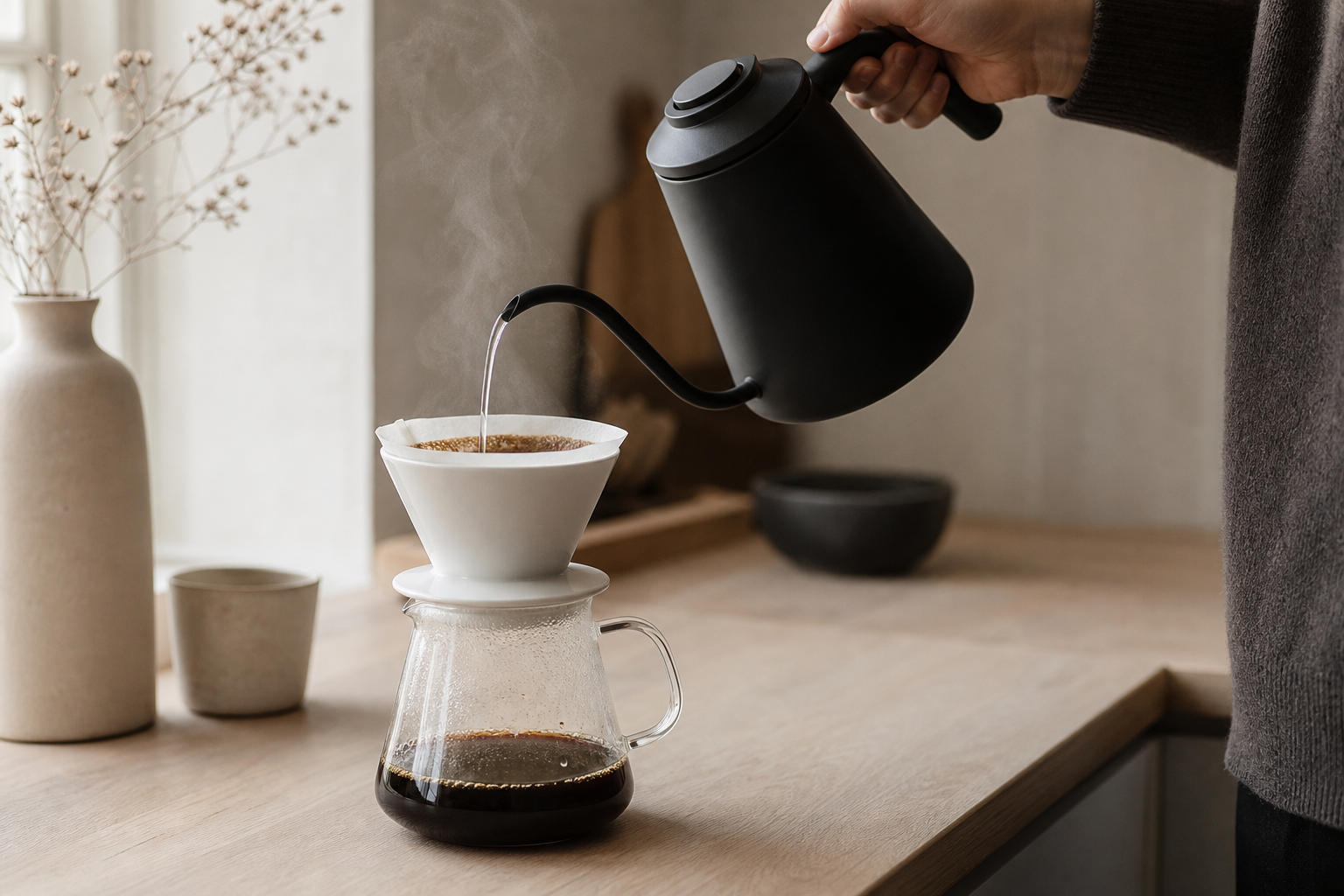
Achieving consistent results at home does not require complicated gadgets. It comes down to getting a few key foundation stones right and building a steady technique.
Core variables for pour-over coffee
Every balanced manual brew relies on four core elements: grind size, coffee-to-water ratio, water temperature, and pouring mechanics.
We recommend starting with a standard coffee-to-water ratio between 1:15 and 1:17. For a balanced single cup, 15 grams of ground coffee to 250 grams of water (a 1:16.7 ratio) yields high sweetness and clean acidity.
Grind size sets your flow rate and contact time. A medium-fine grind works best for conical drippers, while flat-bottom or thick-paper brewers prefer a medium to medium-coarse grind. Uniform grind size matters far more than most people think. A quality hand grinder prevents microscopic fine particles from clogging your paper filter.
[products ids='15609150603594']
For water temperature, aim for 91°C to 96°C. Lightly roasted specialty coffee benefits from water on the higher end of this range to extract delicate floral and fruit notes cleanly.
Ideal ratios and parameters
Different drippers require minor adjustments due to their geometry and filter thickness. Here is a quick breakdown for common pour-over methods:
| Dripper Type | Coffee Dose | Water Weight | Ratio | Grind Size | Brew Time |
|---|---|---|---|---|---|
| Hario V60 | 15 g | 250 g | 1:16.7 | Medium-fine | 2:30 – 3:00 |
| Kalita Wave 185 | 18.5 g | 300 g | 1:16.2 | Medium | 3:00 – 3:30 |
| Chemex (6–10 Cup) | 30 g | 500 g | 1:16.7 | Medium-coarse | 4:00 – 4:30 |
Step-by-step pour-over technique
Consistency requires a calm, repeatable flow. Here is our reliable routine for a single-cup pour-over.
Filter preparation
Fold the paper filter along its seam and set it inside your dripper. Place the dripper on your server or cup. Thoroughly rinse the paper filter with hot water from your kettle to remove paper fibers and preheat your brewing gear. Discard the rinse water before adding ground coffee.
Coffee dose and bed prep
Add 15 grams of freshly ground specialty coffee into the rinsed paper filter. Gently tap the dripper side-to-side to level the bed. Place everything on your scale and tare it to zero.
The bloom phase
Start your timer and pour roughly double the coffee weight in water (around 30 to 45 grams), starting in the center and working outward. The coffee bed will bubble as trapped carbon dioxide escapes. Wait 30 to 45 seconds for the bloom phase to finish.
Main pulse pours
Pour the remaining water in gentle, slow spirals from the center outward, stopping short of the paper filter edges. We recommend dividing the rest of your water into two or three balanced pulses. For instance, pour up to 150 grams, let it drain slightly, then pour up to 250 grams. Keep your kettle spout low to prevent excessive turbulence that pushes fine particles down into the filter pores.
Drawdown and serving
Allow the water to drain completely through the coffee bed. Your total brew time should land between 2:30 and 3:30. Give your server a gentle swirl to blend the layers before pouring into your favorite cup.
Pour-over equipment options
Your choice of dripper shapes the final flavor profile. Conical drippers highlight bright acidity and origin character, while flat-bottom drippers highlight sweetness and body. Thick paper filters produce unmatched clarity.
[products ids='15633509482826,15446350299466']
If you prefer an ultra-clean cup with zero sediment or heavy oils, a classic glass hourglass brewer paired with thick bonded paper filters delivers exceptional clarity when brewing for several people.
[products ids='15446350332234,15446350168394,15446350201162']
Fixes for extraction issues
When your morning brew tastes off, adjusting a single variable at a time will put you back on track.
Sour or weak flavor
If your coffee tastes sharp, hollow, or overly sour, it is under-extracted. Water passed through the bed without pulling out enough pleasant sugars and sweet compounds.
- Adjust your grinder one or two steps finer.
- Use slightly hotter water.
- Extend your pouring time to increase total contact time.
Bitter or astringent finish
If the cup leaves a harsh bitterness or dry sensation on the back of your tongue, it is over-extracted.
- Adjust your grind coarser.
- Lower your water temperature slightly.
- Pour with fewer pulses to reduce bed agitation.
Slow drawdown or clogged bed
If the water stalls and your total brew time stretches past 4:00 minutes, microscopic fine particles have blocked the filter pores.
- Grind coarser.
- Pour more gently without direct contact with the paper filter walls.
- Inspect your grinder burrs for uneven particle sizes.
Water mineral balance
Many of our customers in the Baltics and Scandinavia ask about local tap water. While soft tap water is common in our region, water lacking minerals can leave coffee tasting thin or uninspired. Read our dedicated water quality guide to see how simple mineral adjustments transform your extraction.
Next steps for your daily ritual
Consistent pour-over coffee comes down to weighing your water and grounds, pouring with a steady hand, and adjusting your grind based on taste. Once you establish these simple habits, dialing in fresh specialty roasts becomes second nature.
Grab your gooseneck kettle, pick your favorite brewing device, and craft your next cup with intention today.