

Have you ever wondered why some coffee tastes like blueberries while the average supermarket blend just tastes like burnt ash? The answer lies in a strict global rating system that separates industrial commodity beans from true specialty lots.
The eighty-point standard
In the coffee world, quality is not a matter of subjective opinion. The Specialty Coffee Association (SCA) uses a rigorous 100-point scale to grade coffees. To earn the specialty label, a coffee must score 80 points or higher. Anything below this threshold is commercial or commodity grade.
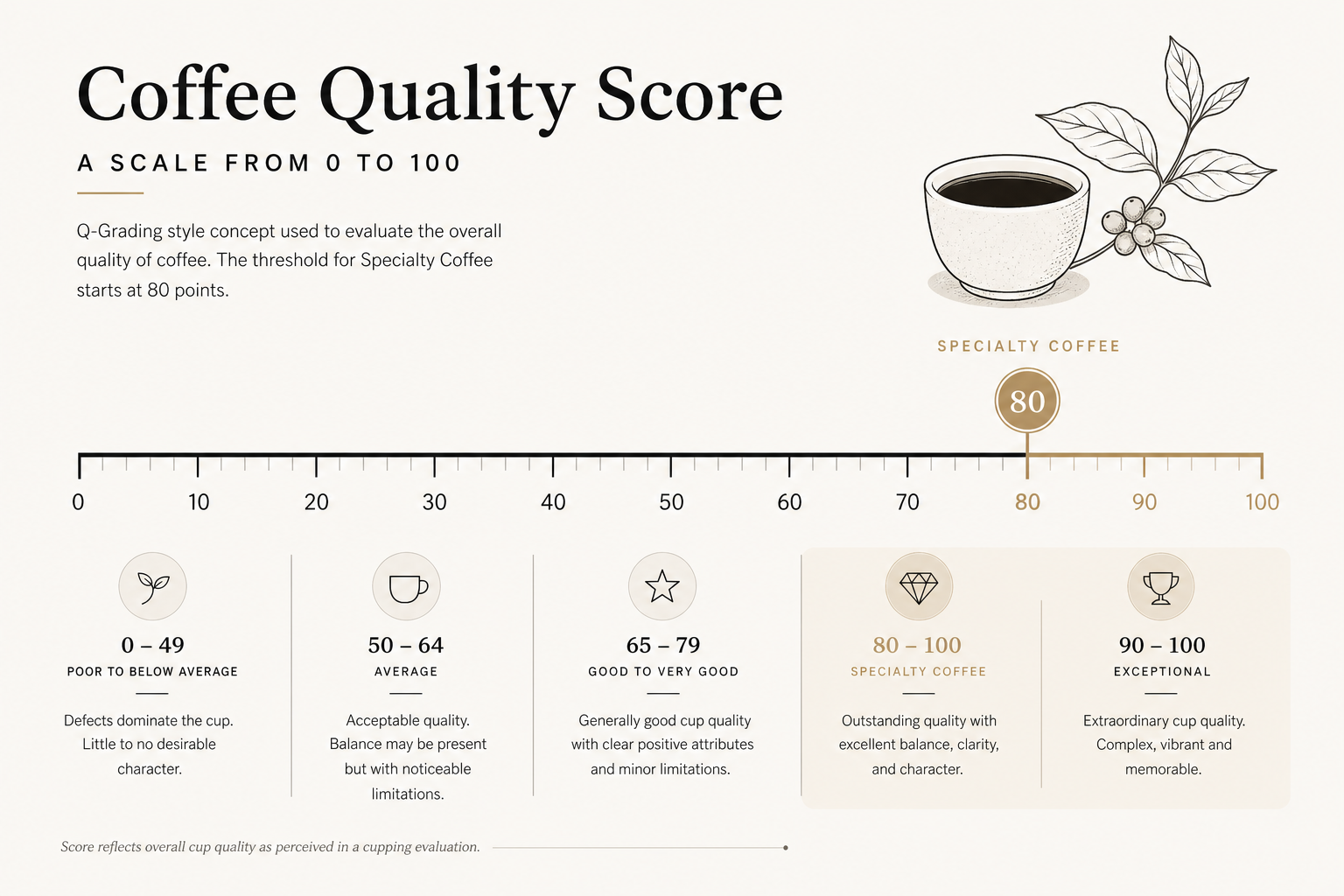
Within the specialty bracket, the scores tell a specific story about what you will experience in your cup:
- 80.0 to 84.99: Very Good. This is the entry point to specialty coffee, offering clean, classic profiles.
- 85.0 to 89.99: Excellent. These coffees display distinct origin characteristics, vibrant acidity, and complex sweetness.
- 90.0 to 100.0: Outstanding. These are rare, highly sought-after micro-lots with exceptional, highly complex flavors.
Many of our customers tell us they never knew coffee could taste like fruit tea until they tried their first high-scoring lot from East Africa. These transparent practices allow you to experience unique coffee tasting notes that represent the actual soil and climate of the farm.
Strict rules for green beans
Before coffee beans ever meet a roaster's flame, they undergo a rigorous physical inspection. Graders analyze a precise 350-gram sample of green, unroasted coffee beans to count defects.
To achieve a specialty grade, the sample must meet two primary criteria:
- Zero category one defects: This means no black beans, sour beans, or foreign objects that would ruin the flavor of an entire batch.
- No more than five category two defects: This limits minor issues like chipped, broken, or insect-damaged beans.
Additionally, the green beans must show a healthy color – typically blue-green, bluish-green, or green. They must also have a water activity level lower than 0.70 aw to ensure stable storage. If a sample fails any of these steps, it is immediately disqualified from the specialty class.
The science of cupping
To determine the final score, certified professionals perform a standardized sensory evaluation called cupping. They use a precise coffee-to-water ratio of exactly 8.25 grams of whole bean coffee per 150 milliliters of water. They pour water heated to 92.2°C to 94.4°C directly over the freshly ground beans.

In our experience, keeping these variables incredibly consistent is the only way to fairly evaluate different origins side-by-side. Traditionally, cuppers score ten attributes, including fragrance, flavor, aftertaste, acidity, body, and balance.
Modern evaluations also utilize the updated Coffee Value Assessment (CVA) standards. This framework separates the objective sensory description from the subjective impression of quality, ensuring a coffee's rating reflects its true value.
For instance, when we evaluated DAK Coffee Roasters' Strawberry Kiss, the distinct notes of strawberry jam were unmistakable. Similarly, the washed process Karinga AB from Good Life Coffee showcases the classic, vibrant acidity that regional enthusiasts love.
[products ids='15590597984586,15446619455818']
Specialty versus commodity coffee
The fundamental difference between specialty and commodity coffee comes down to how the beans are valued, sourced, and traded.
Commodity coffee is treated as a homogeneous, interchangeable product. It is bought in massive bulk quantities, and its world market price (known as the C-price) is set on public exchanges based on global supply and demand. This price fluctuates wildly, often leaving farmers with payouts that do not even cover their basic production costs. The flavor of commodity coffee is generic, often relying on heavy roasting to mask defects and consistency issues.
Specialty coffee is entirely about quality and traceability. Because specialty roasters buy small, specific micro-lots directly from farmers or quality-focused cooperatives, they pay a premium that reflects the actual sensory score. This ensures a fairer, more sustainable income for the growers.
If you want to see how different processing methods impact these complex profiles, we recommend reading our guide on washed vs natural processing.
For those who enjoy a clean and bright filter brew, we recommend the washed La Soledad Guatemala from HAYB. If you prefer a wilder, sweeter profile, the natural House of Plum Peru from DAK Coffee Roasters is an exceptional choice.
[products ids='15593842442570,15590597853514']
Your next brewing adventure
Specialty coffee is more than just a label on a bag. It represents a meticulous chain of care, from the farmer handpicking ripe cherries on a high-altitude hillside to the roaster carefully developing the bean's natural sugars.
When you brew a cup of high-scoring coffee, you are tasting a specific time, place, and variety. Ready to move beyond the generic bitterness of commodity beans? Explore our curated selection of fresh specialty roasts and find your new favorite origin today.